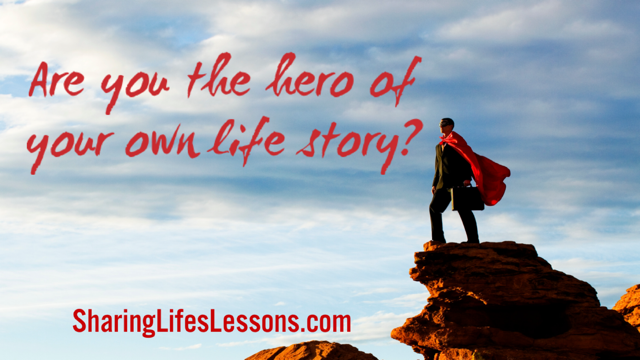
Are you the hero of your own life story?
You may wonder what we are talking about. You may not have written down anything about your life story – yet. Whether or not you are writing it down on paper, you are, in fact, writing your life story every day.
Take a minute to see if you can catch the story about your life that’s going on in your head. When people write a story, or even just tell a story, they describe the characters in a way to make them seem real. Because you are the main character in your life story, how do you see yourself?
Sometimes you might describe that main character (you) in glowing terms. Sometimes you might catch yourself putting this main character down. Research shows that we generally have a lot more negative thoughts than positive thoughts. The reality is that whether your thoughts are positive or negative, you are still crafting your character and your life story.
It’s also true that the actions you take contribute to your life story. You may have decided that doing only positive things in your life is the way to have a successful life story. That certainly sounds like a good idea. If we had total control of our life, then we could write good chapter after another and have a glorious conclusion for our life story. However, that’s not how life happens. Maria Robinson said, “Nobody can go back and start a new beginning, but anyone can start today and make a new ending.”
What got us thinking about this subject is that we heard a sermon recently. The message covered how we have various transitions throughout our life that create our life story. Then, we came across Bruce Feiler who wrote Life Is in the Transitions: Mastering Change at Any Age. With what has happened in the last few years, we all are finding ourselves in some life transitions, so how could we not cover the subject?
Feiler believes the linear life story is outdated. The linear life story goes something like this: Go to school, get a job, get married, have children, retire after 40 years at the same company, and expect to live happily ever after. When that doesn’t happen, it can be a little unnerving. People can become anxious when life is not following the predicted plot of the life story.
In today’s world, life transitions are happening much more frequently. Feiler spent three years traveling to all 50 states talking to people whose lives had been upended by some negative event. He called those events ‘disrupters’. Feiler’s research indicated that the average person experiences about 36 disrupters in a lifetime. People can get through the less serious disrupters with relative ease. However, most people will experience three to five serious disrupters in a lifetime, which Feiler refers to as ‘lifequakes’.
The average length of a lifequake is five years. Lifequakes lead to a time of upheaval, transition, and renewal. So, it becomes important to be able to have the skills to not only survive, but thrive, during those times of stressful transitions and change. Socrates said, “The secret of change is to focus all of your energy not on fighting the old, but on building the new.”
How can we write a new, positive life story when faced with lifequakes? Here are some ideas that may help:
1. Use your strengths, as Feiler calls them, your “superpowers”. Do more of what you do best. By building momentum and confidence, transitions will go more smoothly.
2. Recognize and accept your emotions. In his study, Feiler found the emotion most people identified with during a lifequake was fear. Then came sadness about what had been lost, followed by shame about needing help. These are certainly normal reactions to a new situation.
3. Try something new. This can help you to be creative and ‘think outside the box’ as you work on your new future.
4. Get advice from others you trust. Seek people who support you in the way you want to be supported and comforted. Sharing with others can help keep you from feeling alone on your journey.
5. Write your new life story with you as the hero. Your new life story is about you facing transitions and overcoming your challenges to have a life of purpose, joy and meaning,
What about you? What is your strategy for when a ‘lifequake’ occurs? As author, William Harley Davidson, said, “When writing the story of your life, don’t let anyone else hold the pen.” We hope the ideas presented here will help you be the hero as you write your own life story.
Chanhassen MN residents, Doug and Lynn Nodland are success coaches and owners of The Balance Center in Excelsior. Contact them at WeCare@SharingLifesLessons.com
© Doug and Lynn Nodland 2022 Articles and videos may be shared in their entirety with attribution.
Recent Comments