
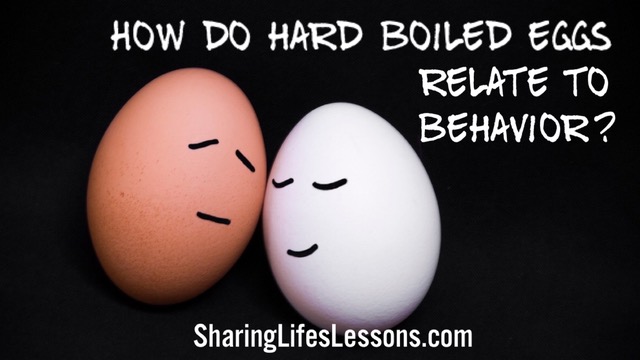
How do hard boiled eggs relate to behavior?
Are you a compliant egg or a defiant egg? You probably are wondering, what is this all about? What got us thinking about this subject recently is that we were peeling shells off of hard boiled eggs. Have you ever noticed that with some eggs the shells peel off quite easily (the compliant egg) with others not so much (the defiant egg). We laughed as we labeled those eggs.
Then we thought about the similarity this can have to how people behave in life. It seems there’s a lot of difficult communication and miscommunication in the world today. Nat Turner said, “Good communication is the bridge between confusion and clarity.” We would like to see people have good communication even when they have different styles of communication and different views. To have that happen, it may be helpful to see how we label people. Let’s look at how easily we label others.
When describing people, have you ever heard someone say, ‘He’s a bad egg or she’s a good egg?’ Then they go on to describe the person’s actions. When people are compliant, they might be referred to as a “good egg”. When people are defiant, they might be referred to as a “bad egg”. Often the label depends on whether we agree with them or not.
Even the terms, ‘compliant’ and ‘defiant’ can be ‘charged’ words with positive or negative connotations. Each of these traits can have two interpretations. Compliant people can be viewed as easy-to-get-along with and agreeable. On the other hand, compliant people can also be seen as wishy-washy and doing whatever they are told to do, without questioning the rationale.
Defiant people may be seen as critical thinkers who are able to think for themselves. However, they may also be seen as going against the grain of popular opinion, and viewed as trouble-makers because they do not comply with the majority.
When you come into contact with someone you classify as either compliant or defiant, or you recognize that you fall into one of these categories, here are some strategies that will help facilitate good communication.
First, whether you agree or disagree with the other person, listen to understand their thinking. In coaching, we call it “active listening”. This means to take in not only the words that are said, but also listen for what’s between the words. Peter Drucker stresses this concept, “The most important thing in communication is to hear what isn’t being said.” Notice the person’s breathing, their pauses and if you can see them, notice their body language. Do they seem to be inviting you in or shutting you out? These are ways you can focus all your attention on them, rather than just thinking about what you’re going to say when they stop talking.
As you actively listen, we encourage you to clarify. If you ask them questions, try to avoid the word “why” as this word tends to make people become more defensive. Research shows that when people state a strong opinion, they are more likely to defend it, even if their opinion is contrary to the facts. We are all familiar with the concept “perception is reality”. To clarify and understand their thinking, you can simply say, “Help me understand.” Or, to be more specific, “Help me understand how you came to that belief.” In his book, Seven Habits of Highly Effective People, Stephen Covey list one of the habits as “Seek first to understand, then to be understood”.
It’s also important to keep an open mind to avoid confirmation bias. Confirmation bias occurs when people avoid, or discount, anything that does not support their belief. This highlights the importance of keeping your mind open to learning what is really the truth, even though it may be contrary to your belief. Mark Twain said, “An open mind leaves a chance for someone to drop a worthwhile thought in it.”
What about you? Do you consider yourself to be a compliant or a defiant person? Maybe the next time you’re peeling hard boiled eggs, you’ll think about the various characteristics of each type of person and how to best communicate so there’s respect and understanding. As Tony Robbins said, “The way we communicate with others and with ourselves ultimately determines the quality of our lives.”
Chanhassen MN residents, Doug and Lynn Nodland are success coaches and owners of The Balance Center in Excelsior. Contact them at WeCare@SharingLifesLessons.com
© Doug and Lynn Nodland 2022 Articles and videos may be shared in their entirety with attribution.
Recent Comments